Political Liberalism: Expanded Edition by Rawls John
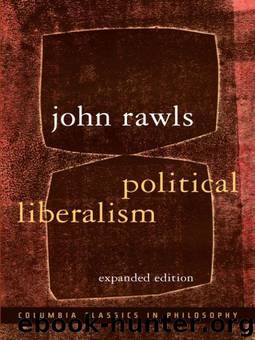
Author:Rawls, John [Rawls, John]
Language: eng
Format: mobi, epub
Publisher: Perseus Books Group
Published: 2011-02-09T16:00:00+00:00
§ 6. Priority of Liberties, II: First Moral Power
Finally we come to the considerations relating to the capacity for a sense of justice. Here we must be careful. The parties in the original position are rationally autonomous representatives and as such are moved solely by considerations relating to what furthers the determinate conceptions of the good of the persons they represent, either as a means or as a part of these conceptions. Thus, any grounds that prompt the parties to adopt principles that secure the development and exercise of the capacity for a sense of justice must accord with this restriction. Now we saw in the preceding section that the capacity for a conception of the good can be part of, as well as a means to, someone’s determinate conception of the good, and that the parties can invoke reasons based on each of these two cases without violating their rationally autonomous role. The situation is different with the sense of justice: for here the parties cannot invoke reasons founded on regarding the development and exercise of this capacity as part of a person’s determinate conception of the good. They are restricted to reasons founded on regarding it solely as a means to a person’s good.
To be sure, we assume (as do the parties) that citizens have the capacity for a sense of justice, but this assumption is purely formal. It means only that whatever principles the parties select from the alternatives available, the persons the parties represent will be able to develop, as citizens in society, the corresponding sense of justice to the degree to which the parties’ deliberations, informed by commonsense knowledge and the theory of human nature, show to be possible and practicable. This assumption is consistent with the parties’ rational autonomy and the stipulation that no antecedent notions or principles of justice are to guide (much less constrain) the parties’ reasoning as to which alternative to select. In view of this assumption, the parties know that their agreement is not in vain and that citizens in society will act upon the principles agreed to with an effectiveness and regularity of which human nature is capable when political and social institutions satisfy, and are publicly known to satisfy, these principles. But when the parties count, as a consideration in favor of certain principles of justice, the fact that citizens in society will effectively and regularly act upon them, the parties can do so only because they believe that acting from such principles will serve as effective means to the determinate conceptions of the good of the persons they represent. These persons as citizens are moved by reasons of justice as such, but the parties as rational autonomous representatives are not.
With these precautions stated, I now sketch three grounds, each related to the capacity for a sense of justice, that prompt the parties to adopt principles securing the basic liberties and assign them priority. The first ground rests on two points: first, on the great advantage to everyone’s
Download
Political Liberalism: Expanded Edition by Rawls John.epub
This site does not store any files on its server. We only index and link to content provided by other sites. Please contact the content providers to delete copyright contents if any and email us, we'll remove relevant links or contents immediately.
| Anthropology | Archaeology |
| Philosophy | Politics & Government |
| Social Sciences | Sociology |
| Women's Studies |
The Secret History by Donna Tartt(19128)
The Social Justice Warrior Handbook by Lisa De Pasquale(12199)
Thirteen Reasons Why by Jay Asher(8927)
This Is How You Lose Her by Junot Diaz(6900)
Weapons of Math Destruction by Cathy O'Neil(6290)
Zero to One by Peter Thiel(5816)
Beartown by Fredrik Backman(5772)
The Myth of the Strong Leader by Archie Brown(5517)
The Fire Next Time by James Baldwin(5458)
How Democracies Die by Steven Levitsky & Daniel Ziblatt(5227)
Promise Me, Dad by Joe Biden(5161)
Stone's Rules by Roger Stone(5092)
A Higher Loyalty: Truth, Lies, and Leadership by James Comey(4974)
100 Deadly Skills by Clint Emerson(4936)
Rise and Kill First by Ronen Bergman(4803)
Secrecy World by Jake Bernstein(4761)
The David Icke Guide to the Global Conspiracy (and how to end it) by David Icke(4730)
The Farm by Tom Rob Smith(4518)
The Doomsday Machine by Daniel Ellsberg(4497)
